Economics is the social science that analyzes the production, distribution, and consumption of goods and services.

This is default featured slide 1 title

Go to Blogger edit html and find these sentences.Now replace these sentences with your own descriptions.

This is default featured slide 2 title

Go to Blogger edit html and find these sentences.Now replace these sentences with your own descriptions.

This is default featured slide 3 title

Go to Blogger edit html and find these sentences.Now replace these sentences with your own descriptions.

This is default featured slide 4 title

Go to Blogger edit html and find these sentences.Now replace these sentences with your own descriptions.

Tuesday, 3 January 2012

Demand

2.0       PRICING THEORIES
2.1       Demand
Definition of demand
Demand is refers to ability and willingness to buy specific quantities of goods in a given period of time at a particular price, ceteris paribus. Ceteris paribus is a Latin phrase that means holding other factors constants while some other factors change. 

Demand =  willingness to buy + ability to buy

Law of Demand
The law of demand states that there is a negative relationship between price of the product and quantity demanded. When the price of the product increase, the quantity demanded of that product will be decrease and when the price of the product decrease, the quantity of that product will be increase, ceteris paribus. 

P increase, Qs increase
P decrease, Qs decrease

Demand schedule and Demand curve
The demand schedule for a product is a list of the quantity that a buyer is willing to buy at different prices at one particular time. Table 2.1 shows the quantity of apples demanded at each price level.
Table 2.1: Individual Demand and schedule for apples.
Combination
Price (RM)
Quantity (units)
A
80
2
B
60
4
C
40
6
D
20
8

The above demand schedule can be shown in a diagram to show how we obtain a demand curve (see Figure 2.1)

The demand curve shows the relationship between the quantities demanded of a product and its price. The demand curve must slope downwards (negative slope) because the inverse relationship between price and quantity demanded (according to the law of demand).


 Individual Demand and Market Demand
Individual demand is shows the relationship between the quantity of a product demanded by a single and its price.
Market demand is shows the relationship between the total quantity of a product demanded by additional all quantities demanded by all consumers in the market and its price.

To discuss about the market demand, assume only have two individual in the market, for example Musa and David. Table 2.2 shows both the individual demand and market demand for the apples.


Table 2.2: The individual and market demand for apples
Combination
Price (RM)
Musa’s Demand (units)
David’s Demand (units)
Market Demand (units)
A
80
2
4
6
B
60
4
6
10
C
40
6
8
14
D
20
8
10
18

Plot the demand curve based on the information given in table 2.2 to show the market demand in a graph paper (see figure 2.2).

economy systems


Economic systems


A.                 Free market economy / capitalist / laissez  faire

Definitions

-          Is an economy system was operation without government intervention.

Features:

-          Decisions are taken by individual and firm with no government intervention.
-          It usually associated with a pure capitalist, where land and capital are privately owned.
-          The price mechanism used in this system whereby changes in price in response to change in demand and supply have the effect of making demand equal to supply.


Advantaged:

-          Individual are free to make their own economic choice
-          Freedom to workers and firm to choose where to work and what production methods to use.


Disadvantages:

-          Existence of wide gap between the rich and the poor.
-          Existence of unemployment problem.


B.                  Centrally planned or command economy / socialist economy


Definitions
-          Is economy was fully controller by government.

Features:

-          Decision are taken by the government or central authorities
-           It usually associated with a socialist or communist economy system, where land and capital are collectively owned. The government or central authorities plans the allocation of resources.

Advantages:

-          Decisions of allocation of resources always are in the interests of society as a whole and with specific national goals.
-          Unemployment could be largely avoided if the government carefully planned the allocation of labour.
-          Same income distribution
-          Produces the goods and services at efficiency level.

Disadvantages:

-          Mistake decide in economy (decision made by some people only)
-          Technology and innovation are undeveloped because all productions are decided by government.


C.                  Mixed economy


Definitions
-          Is a economy system that incorporates a mixture of private and government ownership or control ( capitalism and socialist)

Features:

-          This system use market mechanism and allow government intervention in economy activities.
-          Price level determine by price’s mechanism but basic economy’s problem resolved together between government and private.
-          Individual and firm free to have properties.
Advantages:

-          The government will try to reduce gap of income between rich and poor people. ( taxes and subsidies)
-          Government will also control the existence of monopolies.

Disadvantages:

-            Business freedom is not totally offered for enterprise.


D.                 Islamic economy


Definitions:
-          Economy which uses Allah's creation natural resources with most efficient and fair way based on Islamic laws.

Features:

-          Al Quran and Hadith was the main source in Islamic economics’ activities.
-          Individual free to own property
-          individual no give priority to profit in business
-          fair competition permitted
-          free to decide in economics

Advantages:

-          Good in the world and afterworld
-          Free competition

Production possibilities curve (PPC)

Production possibilities curve (PPC)
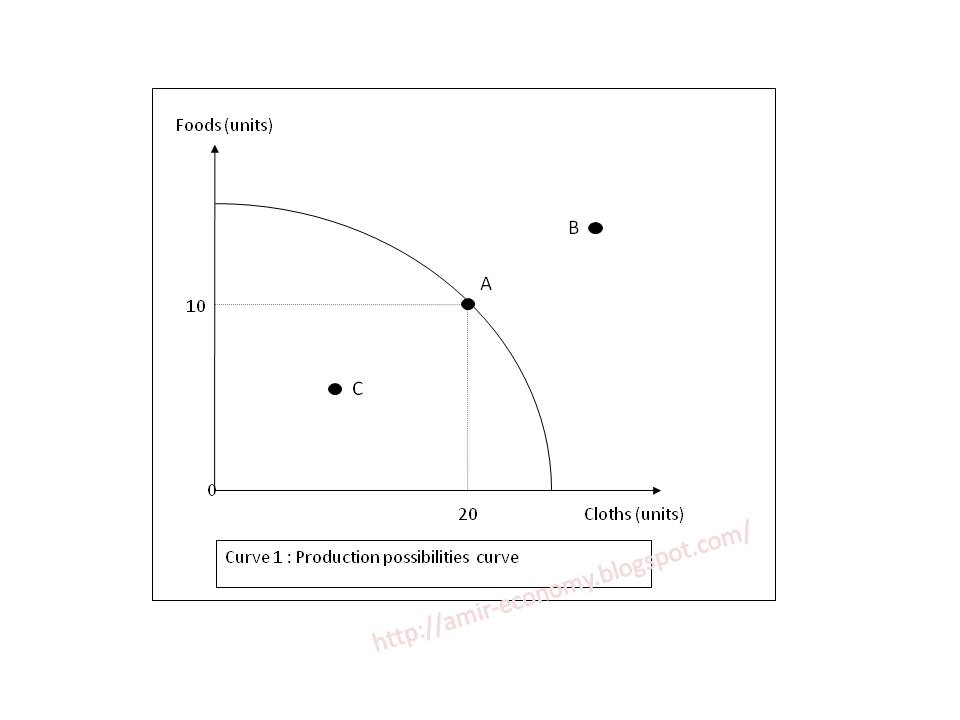
Production possibilities curve (PPC) show the maximum combination on goods that can be produced given the available factors of production and the available technology of production.


Purpose to using the production possibilities curve is:


·         To understand the concept of scarcity and constrained choice.
·         To emphasize the distinction between movements along a PPC and shifts the PPC.
·         To show the concept of opportunity cost using the PPC model.


    3 assumptions to build the PPC


                                                   i.                  There are only two goods will be produce (food and cloth).
                                                 ii.                  The production of technology is available and not changes.
                                               iii.                  Limited factor of production.
                                               iv.              Economy has achieved level of full employment.
 
 
Attainable and unattainable point     
               
     i.                Attainable and efficient combination 
 
With reference to PPC graph, the best possible combinations are point a, b, c, d, and e (attainable). Where resources are fully utilized and the country is said to be at full employment level. The firm is also to be efficient (no waste in the use of resources).
 
                       ii.                Attainable but not efficient combination 
Combination f (inside PPC) is attainable because it can be produced, but the economy is not efficient and the resources are not fully utilized (unemployment exist).
 
  iii.                Not attainable combination  
Combination g is not attainable because it situated outside the PPC. It cannot be producing because not enough resources and no new technology.  
 
 iv.                Extreme combination 
Extreme combination is combination can be produced and it efficient but all resources will use for produce only one goods.